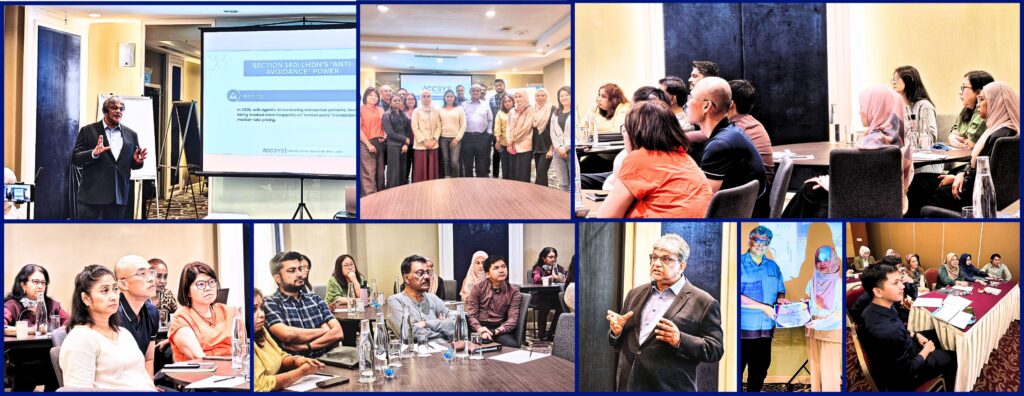
Fundamentals and Implementation of E Invoicing 3 scaled

Struggling with E-Invoicing? Learn Practical Steps for Smooth Implementation.

E-Invoicing is transforming the way businesses issue, manage, validate, and record invoices. As organisations move towards digital tax administration, understanding the requirements and practical application of E-Invoicing has become essential for maintaining accurate records, meeting regulatory obligations, and supporting efficient financial operations.

It is time to move beyond conventional invoicing practices and adopt a structured digital approach that strengthens compliance, reduces manual processes, and enhances the accuracy of business transactions.

Join us for Fundamentals and Implementation of E-Invoicing, a practical training programme designed to equip finance, accounting, tax, and business professionals with the essential knowledge and practical skills required to understand and implement E-Invoicing effectively.

PROGRAM SUMMARY

This professional development programme provides a practical introduction to the principles, requirements, processes, and implementation of E-Invoicing.

Participants will gain an understanding of the E-Invoicing framework, invoice requirements, submission and validation procedures, relevant systems, data management, compliance considerations, and organisational readiness.

The programme goes beyond theoretical knowledge by focusing on practical implementation, helping organisations establish appropriate processes and prepare their teams for effective E-Invoicing adoption.

E-Invoicing Basics

Understand key E-Invoicing concepts and requirements.

Tax Compliance

Learn essential tax and compliance requirements.

Invoice Processing

Learn how to prepare, submit, and verify invoices.

E-Invoicing Setup

Understand how to integrate E-Invoicing into business processes.

Data & Records

Maintain accurate invoice data and digital records.

AI For Finance 59

WHO IS THIS PROGRAM FOR:

  • Finance and Accounting Professionals
  • Tax Managers and Tax Professionals
  • Finance Managers and Executives
  • Business Owners and Company Directors
  • Accounts Payable and Receivable Teams
  • Payroll and Administrative Professionals
  • Internal Auditors and Compliance Officers
  • SME Owners and Management Teams

TRAINING METHODOLOGY

  1. Guided Learning: Build essential knowledge through trainer-led explanations and practical demonstrations.
  2. Practical Business Examples: Review realistic invoicing scenarios and implementation situations.
  3. Hands-On Exercises: Practise invoice preparation, validation, documentation, and related processes.
  4. Implementation Workshops: Assess organisational readiness and identify practical steps for adopting E-Invoicing.

PROGRAM OBJECTIVES

By the end of this programme, participants will be able to:

  • Understand the fundamentals and purpose of E-Invoicing.
  • Recognise key regulatory and operational requirements.
  • Identify the essential information required for compliant invoices.
  • Understand the invoice submission and validation process.
  • Apply appropriate procedures for handling E-Invoicing transactions.
  • Identify potential implementation challenges and operational risks.
  • Strengthen internal processes for E-Invoicing adoption.
  • Support organisational readiness for digital invoicing requirements.

PROGRAM OUTCOMES

Upon completion, participants will be able to:

  • Explain the E-Invoicing framework and its business relevance.
  • Prepare and manage invoice information accurately.
  • Follow appropriate procedures for invoice submission and validation.
  • Maintain reliable digital records and supporting documentation.
  • Identify gaps within existing invoicing processes.
  • Apply practical measures to support regulatory compliance.
  • Coordinate E-Invoicing requirements across relevant business functions.
  • Contribute effectively to the organisation’s E-Invoicing implementation.

PROGRAM OUTLINE

  • Module 1: Introduction to E-Invoicing and the Digital Tax Environment
  • Module 2: E-Invoicing Framework, Requirements and Key Principles
  • Module 3: Invoice Data, Formats and Essential Information
  • Module 4: Submission, Validation and Transaction Processing
  • Module 5: E-Invoicing Implementation and System Integration
  • Module 6: Accounting Processes, Documentation and Record Management
  • Module 7: Compliance, Controls and Common Implementation Challenges
  • Module 8: Organisational Readiness and Practical Implementation Planning

SECURE YOUR SEAT NOW!

Move from manual invoicing to structured digital processes. Build Compliance. Strengthen Accuracy. Prepare Your Organisation for E-Invoicing.

Untitled 600 x 90 px 2

Growing Together

Why Invest in Upskilling
Shopping Cart